Tropical Garden Grow Guide
February 2026 marks the start of introducing common
healing plants that may be in your backyard or close-by.
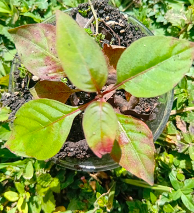
| Botanic name: |
Hamelia patens |
| Other names: |
Ix Canaan, polly red top, scarlet
bush |
| Plant type: |
Evergreen perennial shrub |
| Family: |
Rubiaceae (coffee) |
| Propogation: |
Seeds or cuttings |
| Sun exposure: |
Full sun |
| pH |
6-7 |
| Soil preference: |
Slightly acidic enriched with compost |
| Description |
8-12 feet tall |
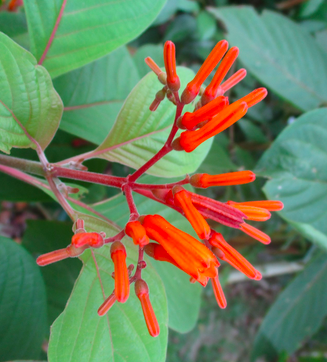
by Mary Loan
In the event you
cannot locate Polly red head plants growing around
your home and garden, ask a friend or neighbor for a
cutting or preferably a small plant or two from their
yard to transplant to a sunny location in your yard. Water the
plants a few times weekly for about one month and they
should continue to grow and spread. Birds’
droppings are also another way plants are propagated.
The leaves, flowers
and bark contain anti-inflamatory and anti-oxidant
compounds. Messages
From the Gods authors Michael Balick and
Rosita Arvigo cover a large number of healing
recipes to treat all types of skin ailments and
infections, including insect bites. Here is
one recipe with many uses: Boil a
double handful of leaves, flowers and fruits in 1
gallon of water for ten minutes then cool and use to
bathe skin ailments six times a day. For fever,
headache, bad wounds, spider bites, skin sores,
scabies, leishmaniasis and itchy skin, boil a large
handful of leaves and flowers in one gallon of
water; drink 1 cup daily and/or use as a tepid bath
twice daily as needed. Polly red head tea is also
commonly used to alleviate menstrual cramps or pain
and as a remedy for non-insulin-dependent diabetes
mellitus. The
stems of the plant can be made to produce iodine.
I was
curious about the taste of Polly red head tea so I
brewed a quart of water with a full handful of
leaves, stems and berries, then let it cool. I found it
to be quite tasty with palatable medicinal
undertones.
Polly
red head tincture can be found at Body Belize
Apothecary shops and outlets in many locations in
Belize. Their headquarters is on mile 26 on the
Hummingbird Highway: http://www.bodybelize.com. For more
information contact bodybelize@gmail.com 501
615-1984. Ask
for Christine.
You can make your
own tincture as well by filling a clean glass jar with
fresh chopped plant material (younger leaves and stems
are best). Then fill jar with 80 + proof vodka, seal
and label with date. Let sit in cool dark place for 6
weeks. Decant and strain out plant material. Best
stored in dark glass bottles to maintain potency for
years. Standard dose is about 20-40 drops in water or
juice 1-3 times daily.
Polly
red head plants are sometimes used for attractive
landscaping and for fencing or floral displays.
Home - Grow Guide Index