Tropical Garden Grow Guide
Where you are the student and the teacher
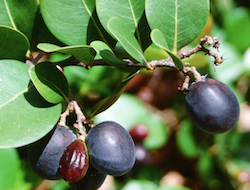
| Botanic name: |
Chrysobalanus icaco |
| Family |
Anacardiaceae |
| Sun exposure: |
Full sun |
| pH |
5.5-6.5 |
| Fruit bearing |
Grafted sapling 3-5 years From pit 7-10 yrs Dwarf plants 2-4 yrs |
| Height |
Container - 6-8ft Orchard - 10-25ft |
August 2026 Plant of the Month
Plums of Belize
By Mary Loan
(Please
note: Coco plums will be the plant of the
month for September as it has
many
unique different qualities than most plums in
Belize)
Plums that grow in Belize are
members of the Anacardiaceae family
which includes the Golden or Paradise plum (Chrysobalanus
icaco), which is one of the most
common and familiar varieties. Other
plums that grow well in Belize are June plum,
Governor (aka Hog plum), Marian plum
(considered to be a plum mango). The
plums can be grown as dwarf
6-8 feet tall container plants to orchard plants
that may grow up to be about 10 – 25 feet tall.
Unpruned trees can sprawl to be around 20 – 30
feet wide. Many are grown as bushes or trees in
the orchard, The
dwarf varieties are sometimes grown as fences.
Plum trees that commonly grow
in Belize are grown to be cultivated as
evergreen shrubs to bushy trees. All
plum bushes and trees produce drupes. Drupes
are fruits with a large seed inside. Most
plum seeds in Belize are covered by fibrous
vegetation. Residents of Belize have
been eating the plums for hundreds of years. Eating
a
warm sun ripened plum picked fresh from the
tree is a special treat. Nowadays
many are harvested when green -- peeled,
cut into slices then sprinkled with salt, red
pepper and lime, sometimes with sugar and sold
in small plastic bags from street vendors or in
the open air markets. Many
Belizeans enjoy the sour, tart fruits during the
dry season when the trees are most productive. Some
find the sour tart green fruits to be
challenging to eat and prefer to wait for the
fruits to ripen and the flavor sweetens and
changes to a pineapple, mango and crunchy sour
apple taste. Fruits will continue to ripen once
harvested.
Monitor the color changes from green to
yellow to red and occasionally to a variety that
produces dark purple fruits. Be
sure to eat them before they become soft and
wrinkled.
Plum
trees
are hardy and require minimal care. Plants
may be purchased at many nurseries in Belize. Once
you have your plant at home, search for a sunny
location that allows at least 20' to 25' feet
apart, or 10' to 15' apart for dwarf or
semi-dwarf trees.
The optimum pH is 5.5 – 6.5.
Dig a hole 3' to 5' wide and deep as the root
ball. Set
firmly in the ground, cover the roots with soil
then cover the top layer with 2” - 3” of mulch. Water
the plant well at least once a week for about 3
months when there is no rain. Planted
from a grafted sapling the tree(s) should bear
in 3-5 years; dwarf plants are said to bear in
2-4 years. Planted from a pit, expect 7-10 years
for the tree to bear fruit.
Plum trees grown in Belize
seldom have plant diseases or insect problems. It is
recommended to spray the leaves and bark a few
times with neem oil spray if mites or thrips are
detected. Be
careful not to over-water to avoid root rot.
Once the trees are in production, harvest
frequently to avoid broken branches from
the weight of the fruits.
Jungle plums are high in
nutrients, including vitamin A, C and K,
antioxidants and dietary fiber. The
leaves and fruit promote heart health and help
to stabilize blood sugar. Leaves
are boiled to use as a gargle for a sore throat
and/or cough or to bathe skin irritations and
wounds.
Here is a simple recipe for
making jam or a beverage made with ripe plums.
Golden Plum Jam
2 cups ripe golden plums and
pits, 1 cup sugar, 1 cup water, 1 Tbs. lemon
juice.
Boil gently for 20-30 minutes
checking and stirring often to prevent
scorching.
Allow to cool then push the
mixture through a sieve and compost the pits and
skin. Place
the jam in a glass jar, use the jam as a dessert
topping or with toast or make a beverage
following the recipe below.
Golden Plum Beverage
Add 10 cups of water to the
jam recipe stir well, cool for at least 2 hours,
add ice and serve.