Tropical Garden Grow Guide --
Where you are the student and the teacher
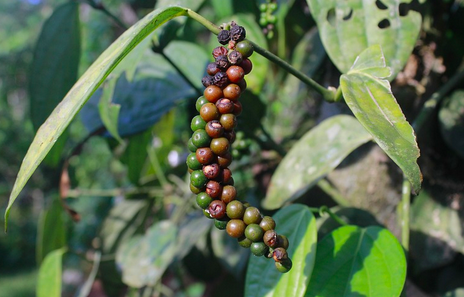
| Botanic name: |
Piper nigrum |
| Family group: |
piperaceae |
| Plant type: |
perennial vine |
| Sun exposure: |
partial shade or filtered sun |
| pH |
5.5-6.5 |
| Soil preference: |
well-drained, loose, organically rich |
May 2025 Plant of the Month
Black Pepper
By Mary Loan
Black
pepper, (Piper nigrum), another
healing plant, is one of the earliest spices
used by our ancient ancestors. It
is called the “king of spices” and is one of
the most highly cultivated and popular spice
plants in the world.
Black
pepper, a woody perennial climbing vine, is a
member of the Piperaceae family. It
is cultivated for its hot pungent tiny fruits-
the peppercorns which grow in abundance in
large green clumps until a majority of the
seeds turn yellowish-red, which means they are
ready for harvest and processing. The drupes
(seeds) contain up to 3% essential oil. The
aroma is penetrating and aromatic and often
triggers a bout of sneezing. The seeds are
processed and dried for use as a culinary
spice and for treatment of many health issues.
If
you choose to grow pepper vines in
your home garden, it is likely you
will be able to keep
a good supply by growing a plant or two. The
vines can grow to be up to 33 feet in height. With
good support and pruning, pepper plants can be
grown in your backyard garden in containers
with drainage or directly in the earth. Keep
in mind that the established vines can live
and produce for 20 to 30 years! The
plants thrive in hot humid weather with
partial shade and consistent moisture, as long
as the roots do not get soggy wet. It takes 3
to 4 years for the vines to mature and produce
peppercorn clusters when grown from seed. The
plants grown from rooted cuttings take a
shorter time - from 1-3 years - to produce
peppercorns ready to harvest. The peppercorns
from the super market are said not to sprout.
Use fresh seeds.
Cuttings are the preferred method. Plants
are available at some nurseries and may be
found at the Belize Spice Farm ready to plant
or you can buy packaged peppercorns processed
for you and save a lot of work.
It is
advised to plant peppercorn seeds at the start
of the rainy season. Choose a location that
gets at least 6 hours of direct and indirect
sunlight daily.
Soak the seeds overnight, then plant
1/4 inch deep in well drained slightly acid pH
5.5 -6.5 loamy soil, 3-4 inches apart. When
the vines are about 6 inches tall plant them
3-4 feet apart. It
takes a few weeks for the seedlings to sprout
and start growing seriously. Be
sure to have your support tree, tippee stakes
or fence in place for the vines to grow on and
be sure to keep the soil moist. When
the vines start to produce pods watch for the
peppercorns changing colour as an indication
of ripeness.
The seeds need to be threshed from the
pods by hand.
In India women dance barefoot on the
pods to release the seeds. The
next step is to plunge the seeds into boiling
water for at least one minute to initiate the
microbes’ enzymatic reaction to turn black. After
the plunge, dry the peppercorns for 5-12 days
in the sun, or in an electric dehydrator days
until the seeds are dry and wrinkled. When
the seeds are completely dry, store them in
glass jars until ready for use.
In addition to being a
savoury seasoning, the peppercorns have many
medicinal uses.
Fresh
ground peppercorns add a tasty bite to rice,
pasta, potatoes, veggies, salads, soups and
casseroles.
The list of medicinal uses is
impressive.
Ground peppercorns can be processed to
make a tincture or infused oil. Crush
½
cup peppercorns, place in a jar, cover with 1
to 1 ½ cups of sesame or olive oil. Place
in a window sill for at least 2-4 weeks, then
rub on painful joints as an anti-inflammatory
agent. Pepper has a solid reputation as an
antioxidant and anti-inflammatory due to the
healing properties of its high-content,
piperine.
It also is helpful to boost brain
health and improve digestion and ease
respiratory issues and aches and pains. Regular
use of black pepper supports blood sugar
management; 1 tsp. per day or less is
sufficient.
Recipe
for making tea; steep 1 teaspoon ground
peppercorns in 2 cups freshly boiled water for
5 minutes, add 1 tablespoon honey then sip to
sooth the throat or as a cough remedy.
Peppercorns combined with turmeric are said to
help absorption of piperine in the
peppercorns.
Next time you make a chocolate cake add
about one teaspoon finely ground black peppers
and about one tablespoon ground turmeric for a
healthy, slightly spicy, tasty undertone.